
Can Medical Intuition Help Solve Hard-to-Diagnose Cases?
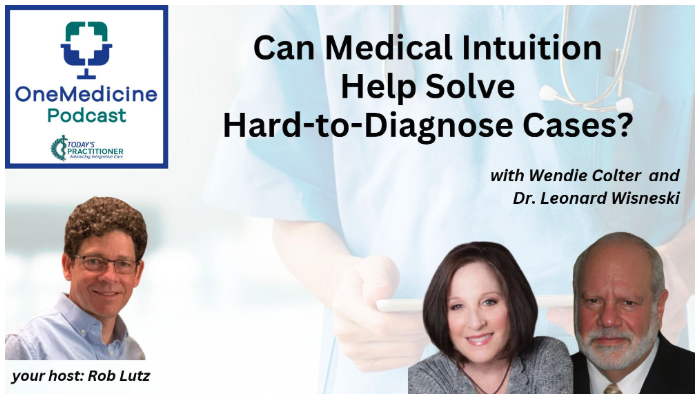
Click here to listen to the OneMedicine podcast! Wendie Colter, Dr. Leonard Wisneski and host Rob Lutz discuss the research, their experiences, and the potential future of Medical Intuition in healthcare.
What happens when someone has ongoing health concerns, but conventional medicine can't quite determine what's wrong? Could Medical Intuition offer another perspective?
Host Rob Lutz invited Wendie Colter, MCWC, CMIP, professional medical intuitive, certified wellness coach, and President of the National Organization for Medical Intuition (NOMI), and Dr. Leonard Wisneski, MD, FACP, and NOMI Advisory Board member, to discuss their new study published in June 2026. The study included physicians, patients, and medical intuitives, who met together to explore difficult, unresolved cases.
In this podcast, Ms. Colter and Dr. Wisneski discuss how Medical Intuition may complement conventional healthcare, particularly when patients have complex symptoms or conditions that are difficult to diagnose.
What Is Medical Intuition?
Medical intuition is an intuitive assessment of the physical body and its energy systems, often referred to as the biofield. It involves intuitively assessing potential imbalances in the body's anatomy and physiology while also identifying the emotional, mental, and life-history factors that may be connected to a person's health.
It’s important to note that Medical Intuition is not a form of medical treatment or intervention, nor is it intended to diagnose, prescribe, or be considered a substitute for licensed healthcare. Rather, it offers additional information that healthcare practitioners can consider when evaluating a patient.
As Dr. Wisneski explains, a medical intuitive may identify something that deserves further investigation, potentially pointing a physician in a direction they hadn't previously considered.
Research Is Beginning to Explore Its Potential
A 2020 blinded study involving medical intuitives trained by Wendie Colter reported remarkable results. The medical intuitives had no knowledge of the 67 participants’ medical records or histories, and their eyes were closed throughout the session. The findings included a 94% accuracy rate in the Medical Intuitive's ability to locate and evaluate the participants’ primary physical issues, 98% accuracy in describing the participant's life events that may have led to the health issues, and 94% consistency with the participants’ known diagnoses.
More recently, Wendie and Len co-authored a study in collaboration with the Institute of Noetic Sciences (IONS), which was published in June 2026 in the peer-reviewed journal Global Advances in Integrative Medicine and Health. This in-depth study explored how medical intuitives might work directly alongside physicians and the accuracy and usefulness of the intuited information to both the physician and the patient.
The study involved six physicians and 40 patients experiencing unresolved health issues or difficult-to-diagnose conditions. Patients first had a conventional medical consultation with the physician. They then participated in a session with both their physician and a medical intuitive.
As in the previous study, the medical intuitives had no prior knowledge of the patients’ medical history or access to visual cues. Their role was to provide an intuitive assessment and share information that might be relevant to the patient's health concerns.
The results were impressive:
All six physicians rated the medical intuitives highly for accuracy and usefulness.
Physicians reported the information was influential to their clinical process and decision-making.
All physicians said they would recommend incorporating medical intuition to their colleagues.
All physicians expressed interest in continuing to use medical intuitives in their practices.
These findings suggest that trained medical intuitives may have an important role as a vital adjunct to integrative healthcare.
Looking Beyond Physical Symptoms
An especially interesting aspect of Medical Intuition is its potential to explore the relationship between physical health and a person's life experiences.
Medical intuition can offer a whole-person perspective, considering not only physical imbalances but also emotional, mental, and spiritual influences. Integrative and complementary healthcare recognizes that a person's health includes looking beyond the immediate symptoms and considering the broader circumstances surrounding their well-being.
This comprehensive perspective can be particularly valuable for patients who have struggled to find answers solely through conventional medical approaches.
A Complementary Approach to Healthcare
Medical Intuition is not intended to replace physicians, medical testing, or conventional treatment. Its value lies in providing an additional source of information that healthcare professionals can consider.
Dr. Wisneski points out that physicians routinely gather information from multiple sources when evaluating a complicated case. A medical intuitive can potentially serve a similar purpose by providing observations that might otherwise go unexplored.
The goal is not to replace established medical practices but to expand the information available to practitioners so they can make more informed decisions.
As interest in integrative healthcare grows, the research and discussions raise a worthy consideration: Could medical intuitives become a recognized resource within conventional healthcare settings?
Greater collaboration between medical intuitives and licensed healthcare professionals, as well as introducing Medical Intuition education into medical training, will continue to move us closer to the goal of medical intuitives becoming integrated into the healthcare team.
For more information on Medical Intuition, visit https://nomimedicalintuition.org